Reading the Marks: Hallmarks to Look for on Your Jewelry
The tiny stamps that tell you what a piece is made of and what it might be worth.
When a piece of jewelry comes across our counter, the first thing I do is turn it over and look for the marks. Before any testing, a hallmark tells me what the piece claims to be: the metal, its purity, and often who made it.
You can do the same thing at home. Most of these marks are a few millimeters wide and easy to miss, but once you know what to look for, you'll never look at your jewelry box the same way.
Here's what to look for, what each mark means, and why it matters for your records.
Where to look, and how
Makers stamp marks where they won't show when the piece is worn. Check these spots first:
• Rings: the inside of the band, usually at the bottom of the shank.
• Necklaces and bracelets: the clasp, the jump ring next to it, or a small tag near the clasp.
• Earrings: the post, the back of the earring, or the butterfly back itself.
• Pendants: the bail (the loop the chain passes through) or the back.
• Brooches: the back of the piece or along the pin.
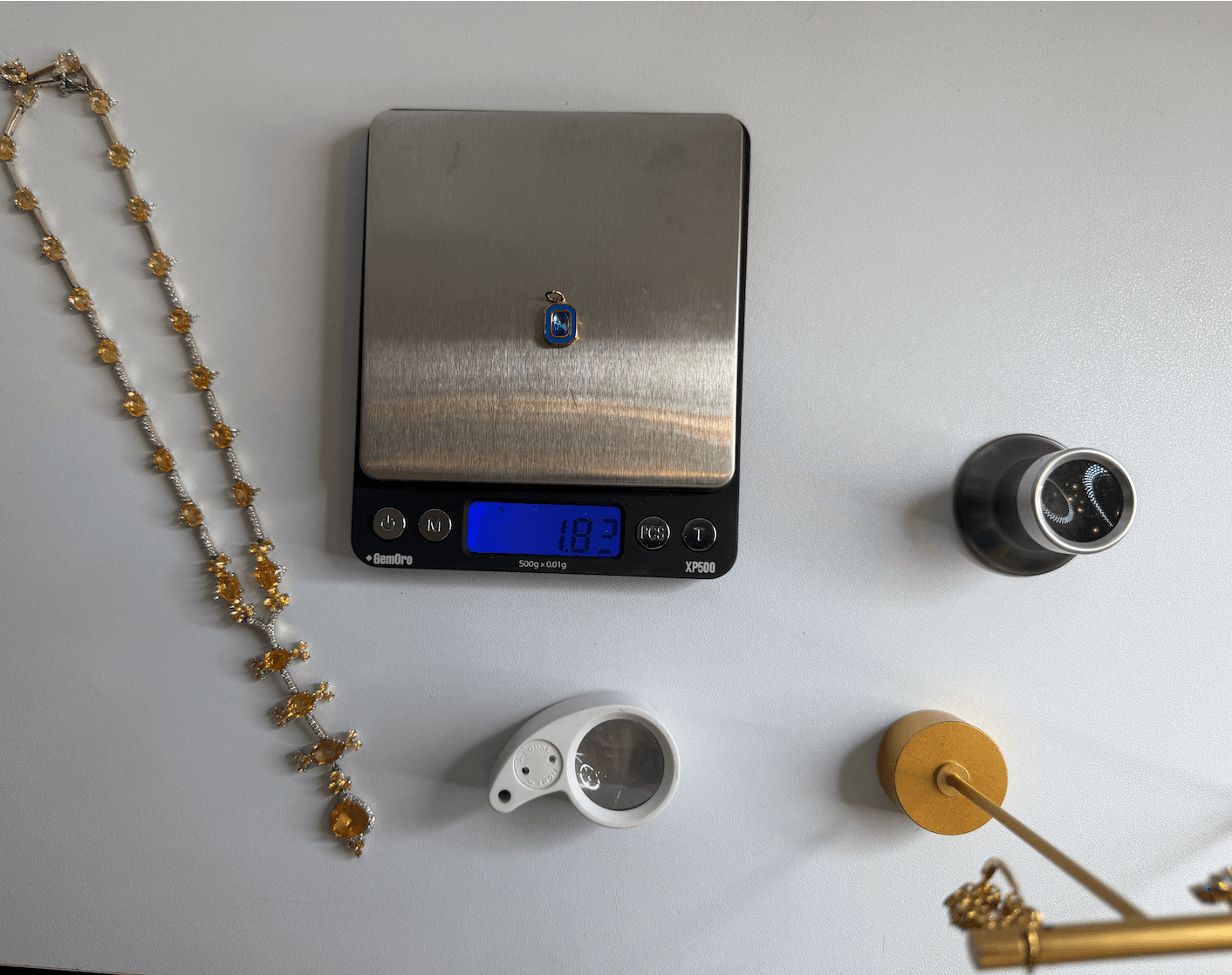
Marks are small and often worn down. A jeweler's loupe (10x magnification) costs a few dollars and makes them easy to read. Your phone's camera works too: use macro mode or zoom in, and shoot in good daylight.
Take a clear photo of every mark you find. You'll want it for your records and to upload to your vault.
Gold: karat stamps
Gold is marked one of two ways. American pieces usually use a karat number followed by a K. European and many vintage pieces use a three-digit number, which is the gold content in parts per thousand. They mean the same thing.
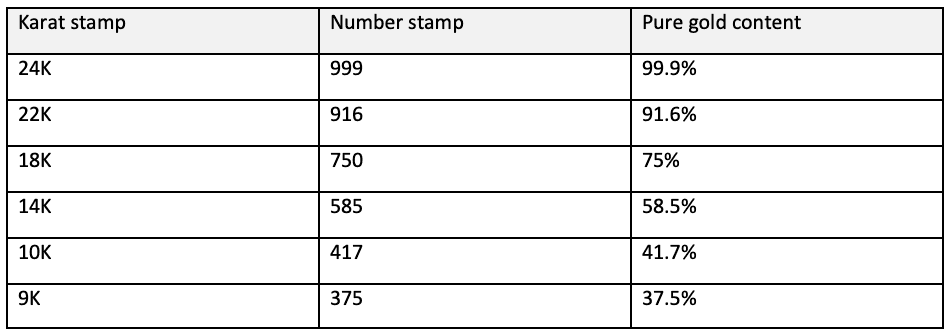
The rest of the metal is an alloy, such as copper, silver, or zinc, that adds strength and color.
This is why karat matters so much for value. An 18K chain has nearly twice the gold of a 10K chain of the same weight. When we price gold at the counter, the karat and the weight are the starting point.
You may also see KP, for "karat plumb." It means the piece meets its karat exactly, with no allowable shortfall. 9K is common on British pieces but is not sold as "gold" in the U.S., where 10K is the minimum.
Silver, platinum, and palladium
Silver
• 925, Sterling, or STER: sterling silver, which is 92.5% silver. This is the standard for fine silver jewelry.
• 800, 830, or 900: lower-purity silver, common on European and antique pieces. "Coin silver" on older American pieces is usually 900.
• 958: Britannia silver, a higher British standard.
• 999 or Fine: pure silver, mostly seen on bullion and some artisan pieces.
Platinum
• PT950, PLAT, or 950 PLAT: 95% platinum, the most common standard for fine platinum jewelry.
• PT900 or PT850: 90% or 85% platinum, often on vintage and Japanese pieces.
Palladium
• PD950 or PALL: palladium, a platinum-family metal used in some wedding bands and white jewelry.
Platinum is denser than gold, so a platinum ring feels noticeably heavier than a gold ring of the same size. That weight is often your first clue.
Marks that mean "not solid"
Some stamps look like a gold mark but tell you the piece is only coated. This is where most people are surprised. A stamp like 14K HGE has a karat number in it, but the 14K describes only a thin outer layer.
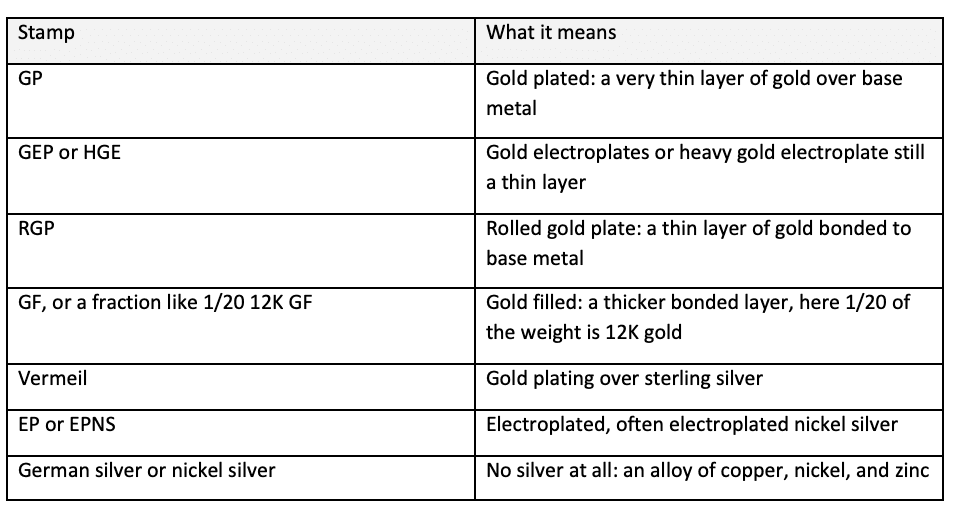
No silver at all: an alloy of copper, nickel, and zincNo silver at all: an alloy of copper, nickel, and zincThese pieces can be beautiful and worth keeping, especially if sentimental, yet their value just comes from design, maker, or sentiment rather than metal content, and that's worth noting in your records.
Maker's marks and international hallmarks
Maker's marks. Next to the metal stamp, look for initials, a logo, or a name. In the U.S., a piece stamped with a quality mark is supposed to carry the maker's trademark too. Recording it can help trace where and when a piece was made.
Designer signatures. Houses like Tiffany & Co., Cartier, Van Cleef & Arpels, and David Yurman sign their pieces, and many add a serial number. A genuine signature can add real value beyond the metal and stones. Be careful, though: designer signatures are also among the most commonly faked marks.
International hallmarks. Some countries require pieces to be tested at an official assay office and stamped with a set of symbols:
• United Kingdom: a maker's mark, a fineness number, and an assay office symbol, such as a leopard's head for London or an anchor for Birmingham. Many pieces also carry a letter that shows the year it was marked.
• France: an eagle's head is the mark for 18K gold.
• Italy: a star, a number, and a two-letter province code, such as AR for Arezzo or VI for Vicenza, which together identify the manufacturer.
If you find a set of tiny symbols you can't read, photograph it. A jeweler or appraiser can often date and place the piece from those marks alone.
Beyond the metal: diamonds and watches
Diamond inscriptions. Many certified diamonds have a number laser-inscribed on the girdle, the thin outer edge of the stone. It matches the stone to its grading report, such as one from GIA or IGI. You'll need a loupe to see it. Lab-grown diamonds are often inscribed to say so, too.
Other stone marks. A CZ stamp inside a ring means the center stone is cubic zirconia, not diamond.
Watches. Luxury watches carry a reference number (the model) and a serial number (that specific watch). Depending on the brand, you'll find them on the caseback, between the lugs, or engraved on the inner ring around the dial. These numbers are what an insurer, buyer, or repair shop will ask for first.
What a mark can't tell you
A hallmark is a great first clue, but it's a claim, not a guarantee. Keep these in mind:
• Marks can be missing. Resizing can remove a stamp from a ring, years of wear can rub it away, and many antique and handmade pieces were never stamped at all.
• Marks can be wrong. Some pieces are stamped at a higher karat than the metal really is, and counterfeit designer pieces often carry convincing copies.
• A mark says nothing about stones. Metal content is only part of a piece's value. Gemstones, craftsmanship, age, and maker can matter far more.
That's why a professional test or appraisal is the final word. A mark tells you where to start.
Record what you find
Every mark you find belongs in your records. When you add a piece to LocketVault, include a close-up photo of each stamp and note exactly what it says in the description: "14K, maker's mark JB, inside shank." If you can't read a mark, photograph it anyway. Your appraiser, insurer, or future self will thank you.
So today or tonight, grab your loupe or your phone, open your jewelry box, and turn a few pieces over. You may learn something new about pieces you've owned for years.
Stay golden,
Lauren